Guides
Exotic Pet Sitting Certifications and Permits in the US: What Owners Need
State and federal permits, venomous species rules, USDA licensing, and what counts as real exotic pet sitting certification before an insurer pays a claim.
What to take away
- There is no national exotic pet sitting certification. Sitters stack a general pet sitting credential, documented species hours, and a working relationship with an exotic vet.
- A USDA Animal Welfare Act license rarely applies to boarding a client's pet, but dealing, exhibiting, or transporting regulated animals can trigger one.
- Venomous reptiles need a state permit in the states that allow them, and that permit is tied to a named handler and a fixed address.
- Federal rules cover injurious species, native birds, and imported animals, so moving an animal across state lines can be a violation by itself.
- A liability policy will not respond to unpermitted possession, so the permit file belongs with the booking form.
Four regulatory layers above your insurance policy
Animal possession is regulated locally, by the state, and federally, with species rules layered on top. A sitter can hold a business license, carry a policy, and still be holding an animal illegally.
This is where exotic pet sitting requirements get missed. Owners ask about experience and rates. They rarely ask whether the sitter's address appears on a possession permit.
Exotic pet sitter liability usually turns on whether that possession was lawful.
State wildlife permits attach to a facility
Most states require a possession permit or license for non-native wildlife held in private hands. Florida's Fish and Wildlife Conservation Commission issues Class I, Class II, and Class III wildlife permits and maintains a conditional species list.
Texas registers dangerous wild animals with local animal control. Arizona issues a wildlife holding license for live wildlife. Georgia and Virginia issue comparable permits for listed species.
These permits name a location, and sometimes a named handler. Boarding a permitted animal at a sitter's home can push both parties outside the permit terms. Ask whether your sitter's address appears on a transfer or an amendment.
Venomous reptile permits for pet sitters
Venomous species are handled state by state, and the conditions differ. Common requirements include documented handling hours, a locked and secure enclosure, a bite protocol, and a facility inspection.
Permits by species group
Species group
- Venomous snakes
- State venomous permit
- Large constrictors
- Invasive species rules
- Native reptiles
- Possession of native wildlife
- Non-native birds
- Import and sale rules
Typical trigger
- Venomous snakes
- State fish and wildlife
- Large constrictors
- State plus federal listing
- Native reptiles
- State wildlife agency
- Non-native birds
- USFWS and USDA
Issuing body
- Venomous snakes
- Named handler, hours, inspection
- Large constrictors
- Federal permit to transport
- Native reptiles
- Collecting or holding permit
- Non-native birds
- CITES paperwork if imported
What sitter must hold
- Venomous snakes
- Large constrictors
- Native reptiles
- Non-native birds
Venomous reptile permits
| Species group | Typical trigger | Issuing body | What the sitter must hold |
|---|---|---|---|
| Venomous snakes | State venomous or conditional species permit | State fish and wildlife agency | Named handler, documented hours, inspection, bite protocol |
| Large constrictors | Invasive species rules | State agency plus federal injurious wildlife listing | No interstate transport without a federal permit |
| Native reptiles and amphibians | Possession of native wildlife | State wildlife agency | Collecting or holding permit, often with limits |
| Non-native birds | Import and sale rules | US Fish and Wildlife Service and USDA | CITES paperwork for imported birds |
A handful of states, including Florida, Texas, Georgia, and Arizona, treat venomous possession as a licensed activity. In others, local ordinances do the work. Check the county, not only the state.
Federal triggers worth knowing
USDA APHIS Animal Care licenses dealers, exhibitors, breeders, transporters, and research facilities under the Animal Welfare Act. Boarding a client's lizard for a fee is not dealing. Brokering, reselling, or transporting animals for regulated purposes can change that.
The US Fish and Wildlife Service maintains the injurious wildlife list at 50 CFR 16. Burmese pythons and several other constrictors cannot be imported or shipped between states without a permit. CITES permits cover internationally protected species.
The Migratory Bird Treaty Act requires a federal permit for native birds. CDC import rules cover nonhuman primates, bats, and certain rodents. The practical detail is set out in How to price pet sitting for.
Exotic animal care certification: what is real
No national body certifies exotic pet sitters. What exists is a stack of credentials. Pet Sitters International awards the Certification in Professional Pet Sitting. The National Association of Professional Pet Sitters awards a Certified Professional Pet Sitter credential. Fear Free offers a pet sitter course.
Species knowledge usually comes from documented hours and a veterinary relationship. Ask whether the backup vet belongs to the Association of Reptile and Amphibian Veterinarians or holds Exotic Companion Mammal Practice certification from the American Board of Veterinary Practitioners.
Example: a two-week booking with a listed snake
An Arizona sitter agrees to board a client's Burmese python for two weeks. The owner drives the snake in from Nevada. The sitter is insured and holds a general certification.
The python is federally listed as injurious wildlife, so that interstate move needed a permit. The sitter also holds no Arizona wildlife holding license.
If a bite or an escape produces a claim, the permit gap is the first thing an adjuster examines. For the claims side of that gap, see exotic pet sitting insurance and liability: what US sitters must know.
Paperwork costs that are ordinary and necessary
Permit fees, background checks, bonding, certification courses, and continuing education count as business expenses. IRS Publication 535 explains ordinary and necessary costs, the standard that covers a venomous reptile permit and a keeper course.
New sitters registering a business name and a local license can begin with the IRS guide to starting a business. Income and deductions from sits are reported on Schedule C, Form 1040.
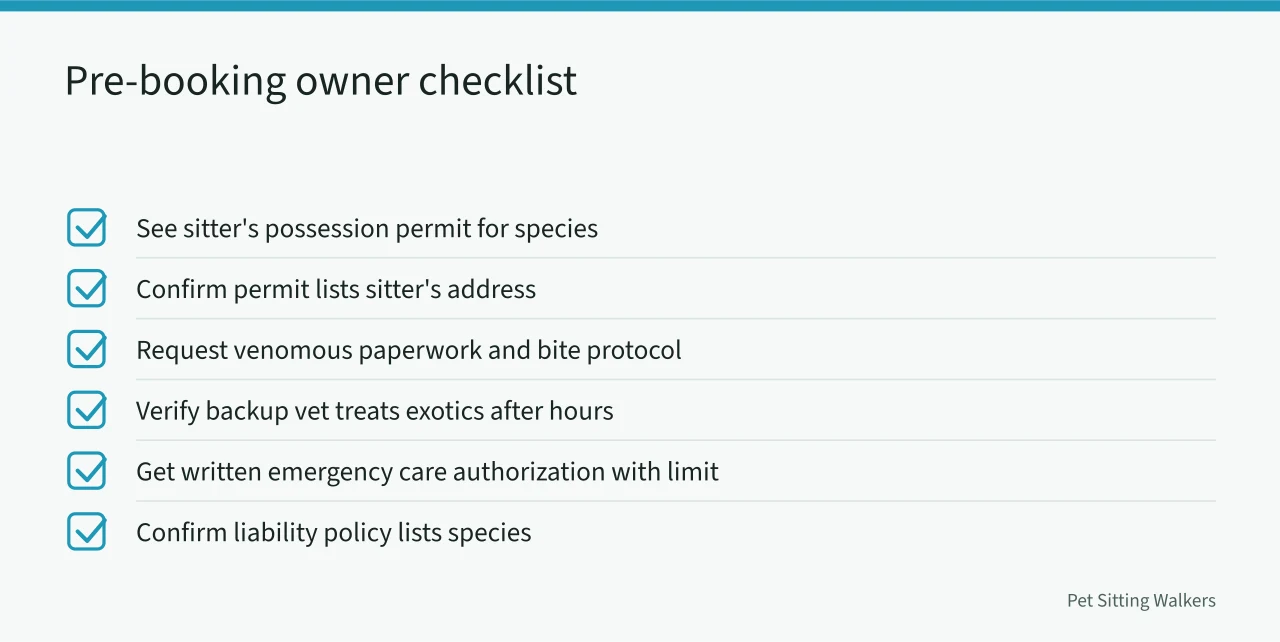
Pre-booking checklist for owners
- Ask to see the sitter's possession permit or license for the species.
- Confirm the permit lists the sitter's address, or that a transfer has been filed.
- Request the venomous species paperwork and the written bite protocol.
- Verify the backup vet treats exotics and can be reached after hours.
- Get written authorization for emergency care with a spending limit.
- Confirm the sitter's liability policy lists the species and does not exclude it.
Common questions
Does a pet sitter need a USDA license to board exotic pets?
Usually no. A boarding arrangement for a client's animal is not dealing or exhibiting. A license question arises when the sitter sells, brokers, exhibits, or transports regulated animals.
Can a sitter keep a client's venomous snake at home?
Only if the state venomous reptile permit names that address and that handler, and the enclosure passes inspection. Many leases and local ordinances prohibit it regardless of state approval.
Is any exotic pet sitter certification legally required?
No state requires a pet sitter certification. The legal requirements are possession permits, business licenses, and insurance. Certifications are a competitive signal to owners.
Who pays if a sitter is bitten by a client's animal?
It depends on the contract and state law. The owner's homeowners policy often excludes business activity, and the sitter's own medical or liability coverage, or an endorsement, is the usual source.